Annual Reports



Human rights define what we are all entitled to — a life of equality, dignity and respect. A life free from discrimination. You do not have to earn your human rights. You are born with them. It’s the same for every man, woman and child on earth. Nobody can give them to you. But they can be taken away.(www.chrc-ccdp.ca) Several human rights tribunals, institutions and courts in Canada work consistently to ensure that these rights are not taken away from any individual due to a personal characteristic such as race, religion, gender or disability. Human rights laws protect people from discrimination and harassment.
One of the wonderful qualities of these professional booklets is the fact that they are written in accessible language that is understood by almost everyone no matter of age or educational differences. The legal terms and definitions are well explained all through the booklets. The illustrations and stories expanded the understanding of human rights concepts, helped in building and developing awareness and created an informative debate among readers. Perhaps the most significant merit of this project is providing newcomers with the opportunity to identify and develop practical skills in dealing with discrimination. This is no doubt a great work to advance human rights education, help people to step outside the mute zone and use the knowledge of their rights as a frame of reference in their relationship with others.
– Ghada Ageel Hamden, Community Educator
The policies, rules and principles are defined in a very simple and understandable way. The format of questions/answers is such an effective way of making different situations clear to the reader. The intent to making people knowledgeable about human rights in diversified scenarios is completely achieved. Case studies have been used in its true sense to identify problems and its solutions for a better understanding. All the important and main topics have been covered, which are part of our daily lives and we have been wondering about our rights and limitations in those particular situations including discrimination at workplace, dealing with service providers and coming across accommodation laws and policies. Illustrations have supported the facts in a very exciting and helpful way, which makes learning fun. Thank you so much for your efforts and help to educate newcomers in settling down and resolving their day-to-day issues.
– Amber Khan MBA, Community Education Coordinator
Canada is now home to hundreds of cultural communities coming from different parts of the world. Because of our commitment to multiculturalism as our national policy, Canadian service providers often face a dilemmawhen intervening in a conflict situation that involves a specific cultural practice. They do not want to offendcultural sensibilities of the involved cultural community. This may sometimes lead to confusing crimes as cultural practices. These communities and their countries of origin are taking every possible measure to identify and punish crimes masquerading as cultural practices. If we fail to do the same, victims of thesecrimes may be left unprotected in Canada and Canada may become a safe haven for the criminals.
These are not familiar crime situations for us. How do we understand them? Do we have laws or othersystemic support in Canada to protect the victims and punish the guilty? As global migrations increase, crimesare beginning to transcend international boundaries. Culprits, who have their bases in many differentcountries, may find it convenient to commit a crime in one country and escape to another country. Protectingthe victims, when crimes cannot be defined or proven, and the guilty cannot be tracked down or punished, is a huge challenge of our time and the entire world is battling against it. Cross-border enforcement of legal actionsis beset with major challenges created by nationalities of victims and offenders, the jurisdiction of courts, recognition and enforceability of foreign judgments, and conflicts between laws of different countries.
This book explores possible solutions to certain crime situations and options available to us through Canadian laws. It presents cases from courts of different countries as examples. It identifies service and system gapsand points to directions for a change. Its message to both service providers and victims is SOLUTIONS EXIST.

Published by the Edmonton Public School Board, Resource Development Service, World on a Maple Leaf: A Treasury of Canadian Multicultural Folktales (available at Amazon.ca, Chapters and Audrey’s) is a collection of 25 folktales that have been written by people from different cultural backgrounds who have called Canada ‘home.’ Rooted in cultures from around the world, the stories not only offer a different imaginative world to the children, but an opportunity to learn different languages, albeit a few words of each, as they delve into the worlds of spiders and foxes, kings and farmers, old women and young maidens, from China, Japan, India, Ireland, Afghanistan, Lithuania, and around the world. While some of the stories have originated outside and then traveled to Canada with people coming here from other parts of the world, others are distinctly rooted in the Canadian soil. These stories will give children an opportunity to study various cultures that have become part of the broader Canadian culture, and see that there are universal elements that we all share as humans irrespective of all kinds of differences. Put together, they bring about the universal ideals of sharing, honesty, perseverance, truth, respect for the elders, helping the needy, defeat of the evil, and the values of human rights and equality. This collection adds to the existing repertoire of children’s literature in Canada.

This manual aims to support victims of spousal/intimate partner abuse, but is not intended as a crisis response manual. Its goal is to strengthen the efforts of the victims to end violence by providing information and support and improving their access to key services. It has been written with consideration for special needs of immigrant women but will apply to any victim of domestic abuse.
Abuse takes place due to imbalance and misuse of power. Thus, it is possible for men also to become victims of domestic abuse. But the population of victims all over the world is largely female. Although, in this manual we have addressed women as victims, the information applies to both men and women without distinction.Non-abuser men are deeply hurt by the abuse of women and support them in their efforts to end abuse in their lives.
Victims of abuse do not have to struggle alone to end abuse. There are many agencies and professionals who can help them in this. This manual aims to encourage the victims to see sense in seeking help, empower them to seek help, and assure them to see hope in their efforts. With this, we hope to be a part of their journey to an abuse-free life.
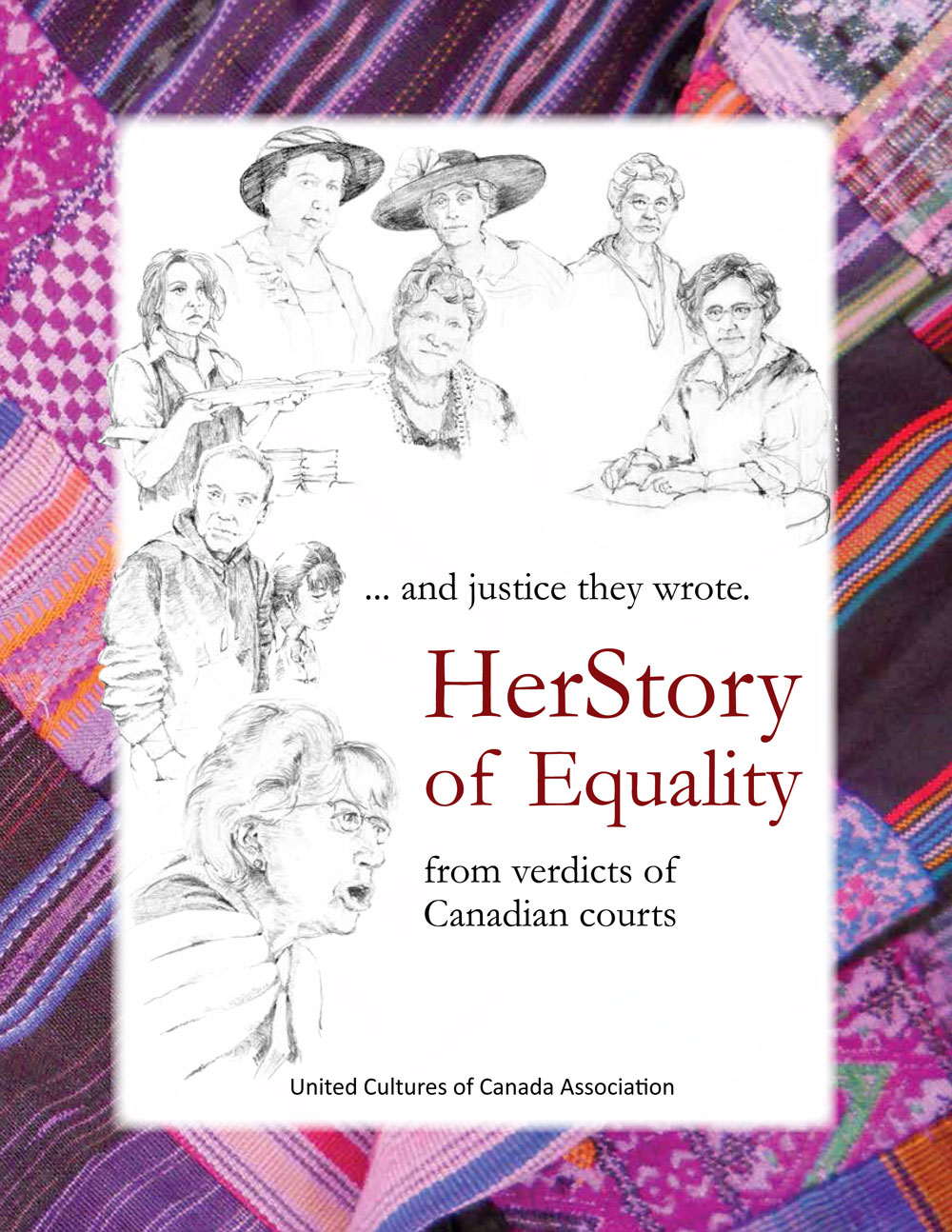
HerStory of Equality from Verdicts of Canadian Courts
“HerStory of Equality from Verdicts of Canadian Courts” presents a brief overview of the progress of women’s equality over the past 90 years. This progress is measured in court decisions that recognized women’s rights to hold high public offices; to get equally paid and be promoted; to make important decisions about their lives, such as marriage and giving birth; and to pursue their lives without suffering harassment on the basis of gender, marital status, reputation, intimate history, or family responsibilities. All these cases represent significant milestones.
Many of these cases went on for several years, with judgments appealed and overturned and fought at several levels of court. They also involved years of work by police, lawyers, judges, and especially by women who refused to give up. Consider how much persistence, determination and, above all, courage may be required to change a law or a custom that has been in place for so long that it has acquired the same force as law!
Court judgments do not apply only to those who are involved in the case; they are meant for the entire society. They formalize a society’s mandate and carry out its collective will to transform itself. The study reminds us of the important role we all have to play by following and advancing the message of these court judgments in both action and spirit.
Today, when many parts of the world are shaken by the attacks and threats of terrorism, which is an ultimate and ugliest form of hate crimes, people in Canada live a relatively peaceful and safe life. One reason for this is that everyone is welcome in Canada and is made to feel so. In Canada, differences and diversity are not only tolerated but celebrated. But to appreciate this, it is important that we know how diversity is protected and promoted in Canada, something that we have achieved through tireless work of many social thinkers and activists, political philosophers and leaders, humanists and constitutional experts over past several decades. Three major Canadian Acts have been largely instrumental in achieving the present status of diversity and inclusion in Canada and have given Canada its unique status.
In 1971, Canada became the first country in the world to adopt multiculturalism as official policy; subsequently, in 1988, the Canadian Multiculturalism Act was adopted. A decade after adopting multiculturalism as official policy, the Canadian Charter of Rights and Freedoms was enshrined as the first part of the Constitution Act, 1982, to ensure life, liberty and security of person as well as equality and legal rights for everyone. It also ensured the freedoms of conscience, thought, belief and expressions for all Canadians. There are some basic rights that come along with being born as a human being. These rights cannot be given to anyone, but they can be taken away. The Canadian Human Rights Act came into force in 1977 to ensure that rights to dignity, respect, and freedom from discrimination cannot be taken away from anyone in Canada. Although there are other criminal, civil, and labour laws, such as hate speech laws, employment equity and equal pay for women, that prohibit exclusion, these three enshrine the quintessential approach to diversity and inclusion in Canada.
Hate crimes originate in biases. In Canada, sustained efforts are made to prevent discrimination and hate crimes involving justice, police, human rights, and many other institutions. However, if we can remove these biases, we may be able to prevent/reduce discrimination or hate crimes to a large extent. Such acts lower the self-esteem, feeling of safety and national pride of the ethnic, faith or other groups that the victim belongs to. Inter-racial harmony is extremely important in a society where hundreds of different cultures must co-exist peacefully and work toward a better society. We need to remind ourselves that such biases, discrimination, and hate toward each other do not have any place in the Canadian society. It is against the spirit and values of Canada.
All Canadians, including those born in a foreign land, need to understand Canada’s total commitment to diversity and inclusion as it informs its policies, principles, and practices. It is time for all of us, as we celebrate Canada’s 150 anniversary, to be reminded of our part in contributing to and strengthening this commitment. It is time to share a forum and envision together a future that is as free of biases and discrimination as is possible and find strategies to work toward a progressively more inclusive society for our children.
To assist interpreters, legal professionals, and communities, we have developed and translated a set of commonly used legal terms into some ethnic languages. These documents have been reviewed/edited by one or more individuals/organizations. All our translators, reviewers, and editors have exceptional credentials, and all the versions have gone through multiple rounds of revision. However, we do not guarantee the accuracy of the translation, and readers are advised to consult other resources also. UCCA or its team of translators, editors, and reviewers will not be responsible for any loss or damage suffered due to reliance on the contents of these documents.
This terminology has been translated into the following languages and is available for free review or download at this website: